

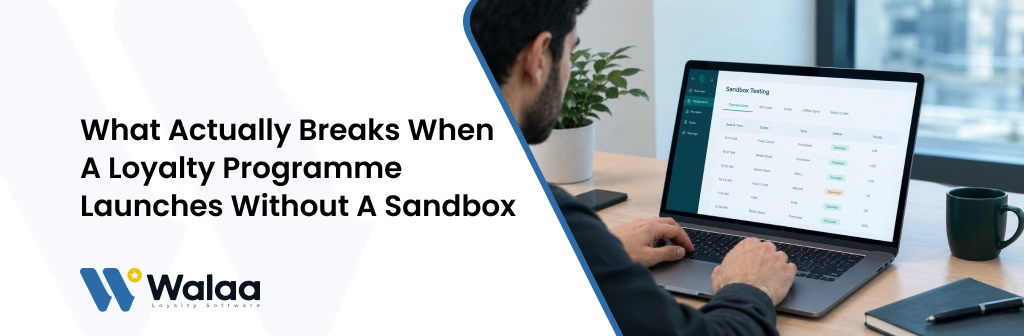
The pressure to skip the sandbox is always the same: the integration looks straightforward on paper, the timeline is tight, and testing against a copy of the POS or PMS feels like a step that can be compressed or skipped without real risk. It's the single most common reason a launch that was supposed to take a week of pilot testing turns into a month of live incident response instead.
The gap between "the API works" and "the programme works"
An integration can pass every technical test — the POS successfully sends a transaction event, the loyalty engine successfully receives it, points get issued — and still be wrong in ways that only show up under real operating conditions. A sandbox loaded with realistic, messy data catches the failures a clean technical test never will:
Duplicate transaction events. POS and PMS systems retry failed network calls, and retries can mean the same transaction gets sent to the loyalty engine twice. Without idempotency handling tested against real retry behaviour, this means members getting double points on a share of transactions — invisible until finance notices the earn rate doesn't match the model.
Refunds and voids. A transaction that earns points and is then refunded needs the points reversed — and reversed correctly even if the member has already spent some of them, which means the engine needs to handle a negative balance or a hold, not silently fail. This is rarely tested until a real refund happens in production and support gets the ticket.
Offline and delayed sync. Restaurant and retail POS systems don't always have a live connection at the till. Transactions queued and sent in a batch once connectivity returns need to land with the correct original timestamp, not the sync timestamp — otherwise a happy-hour promotion that should have applied doesn't, because the transaction appears to have posted three hours later than it happened.
Multi-outlet timing conflicts. A member transacting at two outlets within the same promotional window — common with delivery orders that overlap in-store visits — can trigger edge cases in tier calculations or capped promotional multipliers that never show up when testing a single outlet in isolation.
Why "we'll fix it live" is more expensive than it sounds
The tempting logic is that these are edge cases, and a small number of affected transactions can be manually corrected after the fact. In practice, once a programme is live, every one of these issues surfaces as a support ticket from a real member who noticed their balance is wrong — and member trust in a loyalty programme is disproportionately sensitive to getting the points math visibly wrong in the first few weeks. A member who catches a discrepancy in week one assumes the whole programme is unreliable, even if the actual error rate is small.
There's also a data integrity cost that compounds silently: if duplicate or misfielded transactions aren't caught early, they poison the historical data that later liability modelling and rules simulation depend on. Fixing it eighteen months later means untangling which historical points issuance was real and which was a sync bug — a much harder problem than catching it in a sandbox before launch.
What a proper sandbox phase actually covers
● Realistic data, not clean test data — historical transactions replayed through the integration, including the refunds, voids and retries that a clean test dataset won't include.
● A pilot site running in parallel with the old process for long enough to catch the failure modes above before the full estate goes live — not a same-day cutover.
● A named engineer who owns the integration through pilot, so an edge case discovered on day three of the pilot gets fixed before day four, rather than logged and revisited after full rollout.
● Floor staff testing the actual redemption flow, not just the earn side — a rules engine that issues points correctly but breaks at redemption is still a broken launch from the member's perspective.
The sandbox phase isn't the slow part of the timeline. It's the part that determines whether the rest of the timeline holds.
Why choose Walaa
An eight-week kick-off-to-live timeline only holds up if the sandbox phase is taken seriously, not compressed. Every Walaa rollout runs through a sandbox loaded with your own historical transactions, rules simulated against real baskets, and a named engineer with you through integration — POS, PMS, e-commerce, CRM, whatever the stack is — followed by a pilot site before the full estate goes live. That's the sequence that's taken restaurant groups from kick-off to their first live outlet in seven weeks, not seven months.
Walaa is a loyalty software platform built around a real sandbox and pilot phase, not a same-day cutover.