

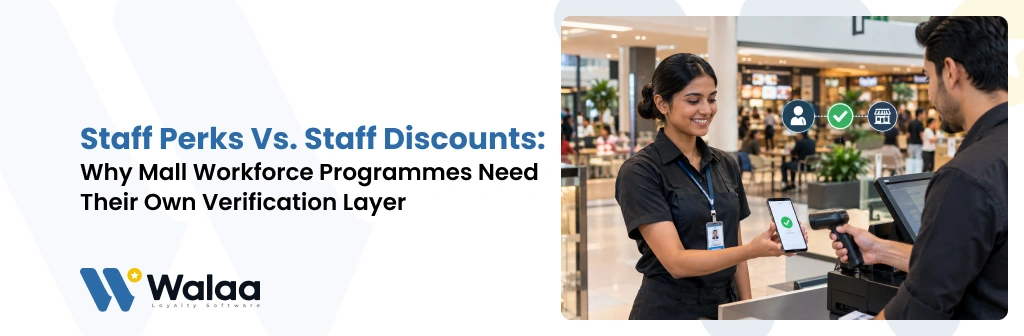
A mall's tenant staff — the people working the food court, the retail floor, the back office — are a captive, high-frequency audience that most mall loyalty strategies skip entirely, because the natural instinct is to build one programme for shoppers and assume staff can just use the same thing. They usually can't, and the reason comes down to a single problem: verification.
Why shopper mechanics don't transfer
A shopper programme verifies a transaction. A staff programme has to verify a person — specifically, that the person redeeming a "staff discount" is actually employed by a tenant in the mall, currently, and not a former employee or a friend using a shared code. Retail loyalty engines built around receipt scanning or POS integration have no native concept of "employment status," and bolting that on after the fact is where most mall workforce programmes stall in build.
This matters more than it sounds like it should, because staff discounts that aren't properly verified get abused fast, and once they're abused, tenants lose confidence in the programme and stop participating — which is the actual failure mode to design against, not fraud in the abstract.
What verification actually needs to check
Current employment, not just a one-time signup. Staff turnover in mall retail and F&B is high. A verification system that checks employment status once, at enrolment, and never again, will have a growing population of "staff" who've since left their jobs but still hold an active discount. Verification needs to be tied to an ongoing feed from tenant HR or scheduling systems, not a static list.
Tenant-specific scope. A staff member at Tenant A shouldn't automatically get discounts at Tenant B unless the mall's programme design specifically includes cross-tenant staff perks — which some malls want, as a way to build goodwill across the whole workforce, and some tenants actively don't want, because it affects their own margin. This needs to be a configurable rule per tenant, not a blanket policy.
Verification at the till, not at the app. The discount needs to check out cleanly at the point of sale — a QR code, a staff card tap, or an ID check integrated with the POS — rather than relying on a screenshot of an app balance, which is trivially shareable and impossible for till staff to verify in a busy service moment.
The tenant onboarding problem, twice over
Mall programmes already have a tenant onboarding cost on the shopper side — getting every tenant's POS wired into the loyalty engine. A workforce programme adds a second onboarding requirement: getting each tenant's HR or scheduling data flowing into the verification layer. Tenants that are slow to provide staff lists, or don't maintain them well, become the weak point in the whole programme — a handful of unverified tenants can undermine trust in the discount for everyone.
The practical answer is to launch workforce perks in phases, starting with tenants who have clean, current staff data and a POS already integrated on the shopper side, rather than trying to launch mall-wide on day one and getting stuck waiting on the slowest tenant.
What actually gets used
Discounts on food and daily essentials drive the highest ongoing usage — staff eat at the food court they work in, most days, and a meaningful discount there gets used constantly. Broader retail discounts across the mall get used less often but matter more for how staff perceive the programme overall — "the mall looks after its people" is a reputational asset that shows up in tenant retention conversations, not just in redemption numbers.
Get the verification layer right, and a mall workforce programme becomes a low-cost, high-frequency engagement tool that also gives the mall genuine data on footfall and spend among the thousands of people who work there every day. Get it wrong, and it becomes a discount code shared in a WhatsApp group within a month.
Why choose Walaa
Verification is the piece most loyalty platforms weren't built to handle, because they're designed around transactions, not employment status. Walaa's mall workforce module ties staff discounts to a live employment feed and tenant-configured scope, checked at the till through POS integration rather than a shareable app screenshot — the same rules engine and tenant onboarding process already running the shopper side of the programme, extended to cover the people working there.
Walaa is a loyalty software platform that malls already trust for tenant onboarding — the same infrastructure extends cleanly to staff verification.