

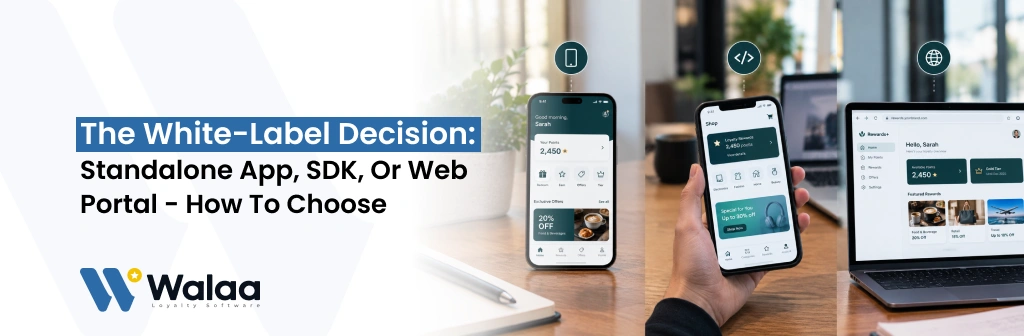
Every loyalty rollout eventually reaches this question, and it usually gets answered by whoever's loudest in the room rather than by what the member actually needs. A standalone member app, an SDK dropped into an app you already have, or a web portal — each is a genuinely different commitment, and picking the wrong one costs months, not weeks.
The default instinct is usually wrong
Most brands' first instinct is "we want our own app" — it feels like the most complete, most branded option. For a brand that doesn't already have a transactional app with real daily usage, this is often the slowest and least effective route. A new standalone app has to earn a place on the home screen from zero, competing against every other app a member already has open. Download friction alone — the gap between "I want to check my points" and "I have to find this in the app store first" — quietly kills engagement for programmes that didn't already have an app-using audience.
SDK: when you already have the audience
If the brand already runs an app with real usage — an e-commerce app, a hotel booking app, a delivery app — dropping a loyalty SDK into it is almost always the stronger option. The member never has to install anything new; the points balance, the tier status and the redemption flow just show up inside an app they already open regularly. This is the route that gets the fastest genuine engagement, because it removes the single biggest drop-off point in loyalty adoption: getting a new app installed at all.
The trade-off is technical, not experiential — an SDK integration needs real engineering time from whoever owns the host app, and it ties the loyalty rollout to that app's release cycle unless the SDK is built to update independently. It's the right choice when the audience already exists inside an app; it's the wrong choice to force onto a brand that doesn't have one.
Web portal: underrated for B2B and lower-frequency programmes
A responsive web portal — no install, accessed through a link or QR code — is consistently underrated because it doesn't feel as "premium" as a native app. For programmes where the interaction is occasional rather than daily — corporate employee benefits, B2B loyalty, coalition partner check-ins — a portal removes install friction entirely and is far faster and cheaper to build and iterate on. Members who check a benefits balance once a month don't need a native app taking up space on their phone; they need a link that works instantly when they click it.
Standalone app: when it's actually the right call
A dedicated app earns its cost when the brand's core relationship with the member is the loyalty relationship itself — a mall programme spanning tenants with no single natural host app, a multi-brand restaurant group where no individual outlet app makes sense as the home for loyalty, or a coalition programme designed explicitly to be a destination in its own right. In these cases there's no existing app to piggyback on, and building a standalone one is the only route to a coherent member experience.
The question that actually decides it
Before choosing, the honest question is: does this brand already have an app members open at least weekly? If yes, an SDK almost always beats building a new app from zero. If no, and the interaction is occasional rather than frequent, a web portal gets a working programme live faster and cheaper than either alternative — with room to build a native app later, once there's real usage data to justify it. A standalone app is the right call specifically when neither of those conditions apply and the loyalty programme itself needs to be the destination.
Getting this decision wrong doesn't just cost build time — it shapes whether members ever form the habit of checking their balance at all, which is the whole point of the exercise.
Why choose Walaa
The reason this decision doesn't have to be permanent is that the engine underneath is the same either way. Walaa ships as a white-label standalone app, an SDK dropped into the app you already run, or a responsive web portal — your logo, your typeface, your tone in any of the three — so starting with a portal and moving to an SDK or a dedicated app later, once usage data justifies it, is a configuration change, not a rebuild.
Walaa is a custom loyalty platform that adapts its front end to how your members actually reach you, without changing the engine underneath.