

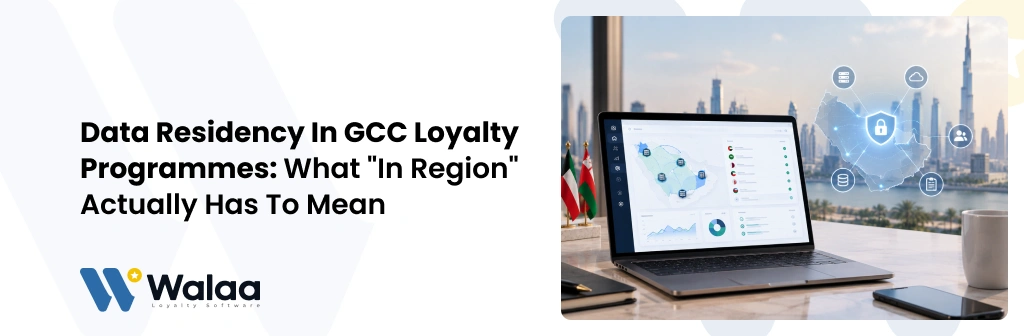
"Where does our member data live?" has moved from a rarely-asked question to one of the first five questions in almost every enterprise loyalty procurement conversation across the GCC, particularly for programmes touching government, banking, or telco members. The answer "in region" gets offered easily. What it actually has to mean, operationally, is more specific than most vendors initially disclose.
"In region" is not one requirement — it's several
Data residency across GCC markets isn't a single unified standard. The UAE, Saudi Arabia, and other GCC states each have their own regulatory frameworks governing personal data, and requirements can differ by sector on top of that — a programme touching government-affiliated members or financial data often faces stricter localisation requirements than a standard retail loyalty programme. A vendor that hosts "in the GCC" without specifying which market, under which regulatory framework, and for which categories of data, hasn't actually answered the question.
For a coalition or multi-market programme — a hotel group operating across the UAE and Saudi Arabia, for instance — this gets more complex, not less. Member data belonging to a Saudi-resident member may need to be held under different terms than the same programme's UAE members, even inside a single unified platform.
What actually needs to be checked, beyond "where's the server"
Where backups and disaster recovery copies live. Primary hosting in-region is the easy part to demonstrate. Backup and failover infrastructure is where residency commitments quietly slip — a backup replicated to a data centre outside the committed region breaks the residency promise even if nobody notices until an audit asks the question directly.
Where third-party processors sit. A loyalty platform rarely operates in isolation — SMS and WhatsApp delivery, payment processing, analytics tooling. Each third-party processor in the stack that touches member data needs its own residency and compliance position checked, because a platform can be fully in-region while a messaging vendor it calls out to is not.
Access logging and role-based permissions. Residency answers where data sits. It doesn't answer who can see it. A defensible position needs role-based access control and a full audit trail of who accessed what member data and when — the question that follows "where does it live" in almost every serious procurement review is "who can access it, and how would we know."
Export and portability. Member data staying "yours" in practice, not just in the contract, means being able to export it in full, on demand, in a usable format — not a promise that becomes theoretical the one time a client actually needs to exercise it, whether that's for an internal audit or a genuine offboarding.
Where this actually shows up in a procurement conversation
Enterprise clients — government entities, banks, large retail groups — increasingly build residency and data governance questions directly into the RFP, not as a follow-up question after commercial terms are agreed. The vendors who lose these conversations aren't usually the ones with a genuinely worse security posture; they're the ones who can't answer the specific version of the question — which market, which data categories, which third parties, what audit trail — because the honest answer was assembled after the question was asked, not built into the platform from the start.
Why this is a platform decision, not a policy document
A residency commitment that lives in a contract but isn't enforced in the platform architecture is a liability, not a safeguard. The platform itself needs to support market-by-market hosting configuration, so that expanding a programme into a new GCC market with a stricter localisation requirement is a configuration decision, not a re-architecture. Retrofitting residency controls onto a platform that was built assuming a single hosting region is a multi-month project that tends to surface exactly when a client is mid-procurement and asking for an answer in days, not months.
Getting this right isn't a compliance checkbox exercise — for the categories of enterprise client most worth winning in this region, it's frequently the first real test of whether the platform underneath the loyalty programme was built for the market it's selling into.
Why choose Walaa
This is the question Walaa is built to answer directly rather than assemble after being asked. Hosting is in the GCC by default, with market-by-market residency configuration available as a programme expands, role-based access and a full audit trail on every change, and full member data export available on demand — the platform already runs for clients including government entities and major regional banks who asked exactly these questions first.
Walaa is a loyalty software platform built with GCC data residency as a default, not a retrofit.