

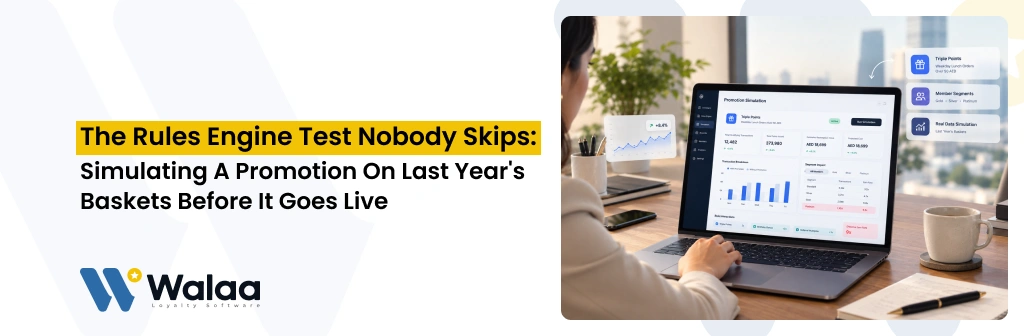
A marketing team writes a promotion — "triple points on weekday lunch orders over 50 AED" — and it looks clean on a slide. Then it goes live, and finance discovers three weeks later that a segment of members had already been stacking it with a birthday bonus and a referral multiplier, and the effective earn rate on 4% of transactions was closer to 9x than 3x.
This is the failure mode simulation exists to catch, and it's the one step almost every programme skips the first few times, because it feels like it slows down a campaign that marketing wants live by Friday.
Why "it looked fine in the spec" isn't enough
A promotion rule reads simply in isolation: triple points, weekday lunch, over 50 AED. The problem is never the rule on its own — it's the rule interacting with every other rule already live in the engine. Tier multipliers, birthday bonuses, referral bonuses, partner exchange rates: a well-run programme has a dozen or more active rules at any time, and a new promotion doesn't get evaluated against a blank slate. It gets evaluated against all of them, simultaneously, for every member segment that qualifies.
Simulating the rule against real historical transaction data — not a hypothetical average basket — is the only way to see what actually happens when the new rule meets the old ones. Run "triple points, weekday lunch, over 50 AED" against last year's actual baskets and you'll see:
● The real number of qualifying transactions, not an estimate based on average order value.
● Which member segments the promotion disproportionately rewards — often not the segment marketing intended.
● The stacking effect with existing multipliers, including the combinations nobody thought to check.
● The actual cost, in issued points and projected redemption, not a back-of-envelope number.
What a proper simulation catches
Unintended stacking. The most common and most expensive failure. A tier multiplier plus a promotional multiplier plus a partner exchange bonus can compound into an earn rate nobody signed off on, and it's almost always concentrated in your highest-value member segment — the people transacting most, who trigger the most rules at once.
Segment concentration. A promotion aimed at driving weekday footfall can, in simulation, turn out to overwhelmingly reward members who were already ordering on weekdays. The cost is real, the behaviour change is close to zero, and you only find that out by running it against people who already behave that way.
Redemption capacity mismatch. Simulation shows you the points issued. It's worth then checking that against the rewards catalogue: if a promotion is projected to issue a volume of points that the catalogue can't realistically absorb in redemptions, you're building future breakage liability, not engagement.
Cannibalisation of a concurrent promotion. Running two live promotions that both apply to overlapping transactions is more common than teams expect, particularly across different channels — dine-in and delivery running separate campaigns that both fire on the same order.
Making simulation part of the workflow, not an extra step
The reason this gets skipped isn't that teams don't understand the risk — it's that simulation is treated as a separate, slower process bolted onto campaign planning. It has to be part of the same workflow the campaign is built in: marketing configures the rule, runs it against a sandbox loaded with real historical baskets, sees the projected cost and segment impact immediately, and adjusts before anything goes live. If simulation means opening a ticket with a data team and waiting two days for a spreadsheet, it will get skipped the first time there's a deadline — which is exactly when it's needed most.
The goal isn't to slow marketing down. It's to let them see the real cost of a rule before members do, rather than after.
Why choose Walaa
Simulation only works if it's part of the same workflow the campaign is built in, which is exactly how Walaa's rules engine is designed. Marketing writes earn and burn logic in plain language — no ticket to IT, no release cycle — and can run it against your own historical baskets before anything goes live, seeing the projected cost and segment impact immediately. Changes that would take a development sprint on a legacy system are a same-day config change here, with a full audit trail of who changed what and when.
Walaa is a loyalty software platform built so marketing can write and test rules directly, without waiting on engineering.