

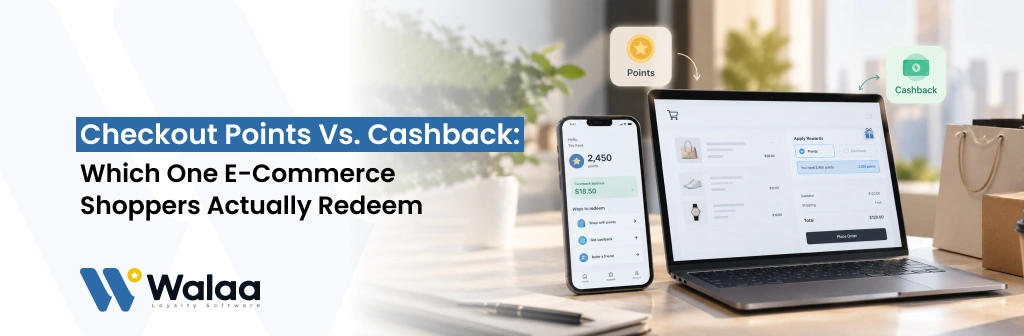
Most online retailers building a loyalty programme ask the same question in the first workshop: points or cashback? It's usually framed as a branding decision — points feel more "loyalty programme," cashback feels more honest. It isn't a branding decision. It's a redemption-rate decision, and the two mechanics behave very differently once real shoppers are in the system.
The redemption gap
Cashback is easy to understand and easy to under-deliver on. A shopper sees "2% back," mentally converts it to cash, and expects it to behave like cash — available immediately, spendable anywhere. When it's actually a store credit that unlocks after 14 days and can only be used in $10 increments, the gap between the promise and the mechanic shows up as complaints, not repeat purchases.
Points, done properly, carry less of that baggage because nobody expects a point to equal a dirham on day one. That gives you room to design the exchange rate, the redemption thresholds and the catalogue around your actual margin — without shoppers feeling shortchanged, because the expectation was never "this is basically cash."
The trade-off is that points need a reason to exist. If redeeming them is confusing, or the catalogue is thin, they sit in the account unspent — which is good for your breakage line and bad for the thing loyalty programmes are supposed to do, which is bring the member back.
What actually drives the decision
Basket size and frequency. High-frequency, lower-basket categories — groceries, beauty replenishment, fast fashion — tend to do better with points, because the redemption becomes a small, recurring reason to return: "I'm close to my next reward, might as well order this week." Cashback doesn't create that same pull toward a specific next visit; it just quietly reduces the price of whatever you were going to buy anyway.
Margin structure. Cashback that's genuinely redeemable as cash or unrestricted credit is a direct margin hit on every transaction, with no lever to manage it beyond the percentage. A points programme lets you set the earn rate, the redemption catalogue and the burn rate independently — so a promotional period can boost earn without permanently reshaping your margin.
Referral mechanics. Points integrate naturally with referral rewards — "500 points when a friend's first order ships" reads as a bonus. The same offer in cashback terms starts to look like a paid acquisition cost line, which finance will treat very differently.
Where the platform work actually happens
The mechanic matters less than the checkout experience around it. The three things that consistently separate a programme shoppers actually use from one that becomes background noise:
● Points or cashback balance visible at checkout, not buried in an account page shoppers have to navigate to separately.
● Real-time earn confirmation the moment an order is placed, not a batch job that updates balances overnight — shoppers who don't see the reward land immediately assume it didn't work.
● A redemption threshold shoppers can actually reach. A points catalogue where the cheapest reward needs eight future orders to unlock reads as a programme designed to never pay out, and shoppers notice.
Referral rewards deserve the same rigour: they need to be wired into the checkout API directly, with the reward triggered by a qualifying event (a completed first order, not just a signup) — otherwise you're either paying out referrals that never convert, or losing the ones that do because nobody tracked the link back to the redemption.
The answer, usually
For most GCC e-commerce brands running repeat-purchase categories, a hybrid tends to outperform either mechanic alone: points for everyday earn and redemption, with an occasional cashback-style promotional credit for high-value moments like a first purchase or a win-back campaign. The point isn't to pick a side — it's to match the mechanic to how often the shopper is actually meant to come back.
Why choose Walaa
Whichever mechanic you land on, it only works if it's wired directly into checkout rather than bolted on as a separate widget shoppers have to think about. Walaa's checkout API handles points, cashback credit and referral rewards in one call, with balances confirmed in real time — not a batch job that updates overnight — and a rules engine that lets marketing adjust the earn rate or launch a promotional credit without a release cycle. The rewards catalogue and referral tracking sit in the same platform, so a threshold shoppers can actually reach isn't a separate integration problem.
Walaa is a loyalty software platform built to plug straight into your store's checkout, not sit beside it.